China’s public spaces are changing quickly. Streets, parks, transit hubs, plazas, and waterfronts now require safer and smarter illumination. Lighting Solutions For Public Spaces must support visibility, comfort, energy efficiency, and local identity. A bright space is not always a successful space.
The International Energy Agency reports that lighting uses about 15% of global electricity. It also produces roughly 5% of worldwide greenhouse-gas emissions. These figures make efficient public lighting a practical climate strategy, not merely a design preference. In China, LED replacement, adaptive dimming, solar integration, and connected controls can reduce unnecessary nighttime consumption. The China Association of Lighting Industry also identifies intelligent lighting and energy-saving products as important industry development directions. Still, technology alone cannot solve every problem.
Dr. Mark S. Rea, former director of the Lighting Research Center, stated, “Light is the stimulus, vision is the response.” His principle reminds designers to evaluate human experience, not only fixture output. A well-planned street should reveal a pedestrian’s path, facial expressions, curb edges, and approaching vehicles. It should avoid harsh glare through careful shielding and accurate photometric design. Color temperature matters too. Excessively cool light can feel sterile beside historic architecture or residential streets. The ideal solution may be less dramatic than expected. That is worth reconsidering.
This article examines China’s best Lighting Solutions For Public Spaces through performance, maintenance, environmental responsibility, and user comfort. It considers national conditions, international lighting guidance, and real operating challenges. Reliable results depend on measured illuminance, uniformity, controls, and regular inspection. Beauty helps, but evidence must lead.
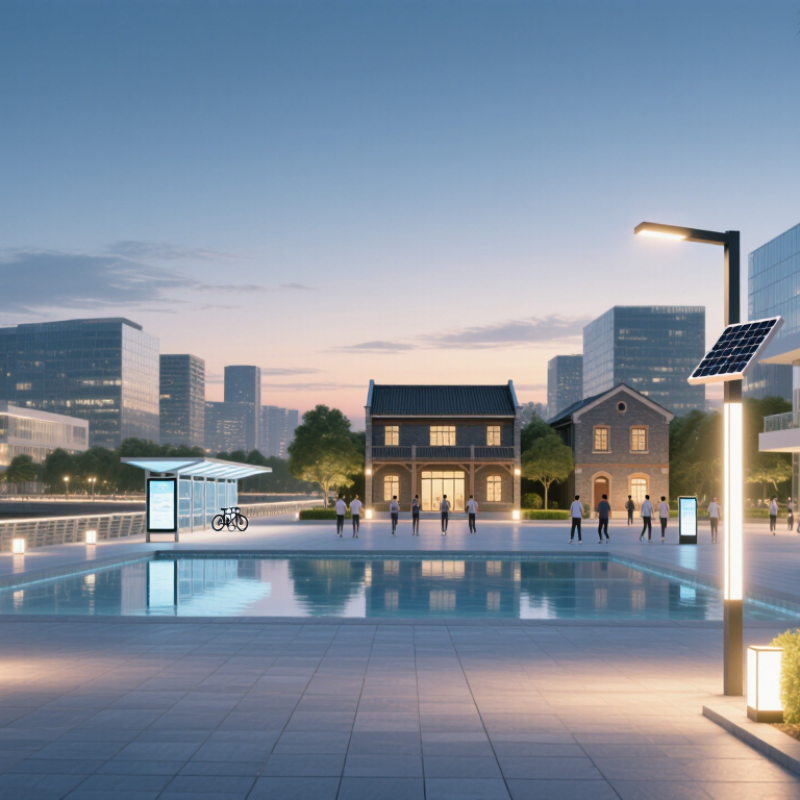
Public-space lighting succeeds when measured need leads design, not decorative brightness. For roads, a starting target of 15–30 lx can support vehicle awareness and basic pedestrian visibility. The exact value depends on traffic speed, conflict points, weather, and surface reflectance. CIE 115:2010 emphasizes lighting classes and uniformity, not illuminance alone. That distinction matters.
Walkways usually need more visual detail. A working range of 100–300 lx can help people recognize steps, faces, signs, and surface changes. EN 13201-2:2015 links road-lighting performance with maintained values, uniformity, glare, and surrounding conditions. A 300 lx target everywhere may waste energy and create uncomfortable contrast. Field trials should check dark corners, tree shadows, wet pavement, and aging lamps.
The Illuminating Engineering Society’s RP-8-22 also treats pedestrian activity, conflict areas, and perceived security as design inputs. Use calibrated illuminance meters at the walking plane, then record readings across a grid. Do not trust one central measurement. One practical concern remains. Context changes perception. A 100 lx walkway may feel dim beside a bright storefront, while 300 lx may feel harsh in a quiet park. Designers should test the proposed levels after installation and review results with users, maintenance teams, and accessibility specialists. Targets need revision.
Public-space lighting in China must balance efficiency, visibility, and local conditions. Good fixtures should deliver 100–180 lm/W at the system level. The U.S. Department of Energy’s 2023 Solid-State Lighting R&D Opportunities report notes that LED packages can exceed 200 lm/W in laboratories. Real luminaires perform lower because optics, drivers, and heat reduce output. That gap matters.
Consider a plaza requiring 50,000 lumens. A 100 lm/W fixture uses about 500 watts. A 150 lm/W fixture needs roughly 333 watts. Over long operating hours, the difference becomes measurable.
However, higher efficacy alone does not guarantee better public lighting. Poor glare control can make a bright walkway uncomfortable. Narrow optics may also create dark spaces between poles.
CRI ≥70 is a practical baseline for roads, parks, transit entrances, and civic areas. It supports recognizable faces, signs, pavement markings, and basic landscape colors. The Illuminating Engineering Society recommends reviewing color quality beyond CRI, including TM-30 metrics such as Rf and Rg. CRI can hide weak red rendering. That is an easy specification mistake.
Field checks should measure illuminance, uniformity, glare, and actual power after installation. Controls can reduce output during quiet hours, but overly aggressive dimming may affect perceived safety.
The International Energy Agency’s energy-efficiency reporting consistently identifies lighting upgrades as a major electricity-saving opportunity. Still, every site differs. A 180 lm/W fixture is not automatically the best choice.
In China’s public spaces, lighting should support comfort, safety, and clear visual guidance. A practical CCT range is 2700–4000 K. Warmer 2700–3000 K light suits residential streets, waterfront paths, and quiet parks. It feels calmer at night and can reduce visual harshness. Neutral 3500–4000 K light works better in transit plazas, civic entrances, and busy walkways. It improves surface visibility and helps people recognize signs, steps, and other pedestrians.
CCT alone cannot guarantee good lighting. Designers should check illuminance, glare, color rendering, and spacing during an on-site night review. Uniform light is especially important near stairs, crossings, ramps, and changes in pavement. Sudden bright and dark areas can confuse older visitors or people carrying luggage. In practice, a 4000 K solution may look too cold in a quiet garden. A 2700 K solution may feel too dim or yellow near active transport areas. There is no universal setting.
Tips: Test 2700 K, 3000 K, and 4000 K samples on location before approval. Compare them after rain and during peak evening use. Keep pole spacing consistent, shield direct glare, and record readings at pedestrian height. Review the space from several approaches, not only beneath the fixture. Small mistakes appear quickly. Maintenance also matters. Dust, aging components, and damaged covers can reduce uniformity, even when the original design was sound.
What Are China’s Best Lighting Solutions for Public Spaces?
Integrate Smart Controls to Achieve 20–50% Energy Savings
China’s public spaces need lighting that responds to real activity. Parks, transport areas, plazas, and community paths rarely need full brightness all night. Smart controls combine motion sensors, daylight detection, scheduling, and dimming. When properly commissioned, these systems can reduce lighting energy use by 20–50%. Actual results depend on occupancy, climate, operating hours, and equipment efficiency.
A practical project begins with a measured energy baseline. Engineers should record nighttime activity, existing illumination, and peak demand before changing settings. A central controller can dim pathway lights after midnight, then restore brightness when movement appears. Daylight sensors can reduce output near open entrances and covered walkways. Each zone needs clear thresholds. Poorly positioned sensors may trigger unnecessary brightness or leave dark spots.
Small changes matter. Operators should test scenes during rain, holidays, and busy weekends. Maintenance teams also need access to fault records and manual controls. A system that saves energy but frustrates pedestrians is not a successful solution. Some projects promise aggressive savings, yet ignore comfort, accessibility, or commissioning time. That deserves reflection. Reliable performance comes from gradual adjustments, visual checks, and monthly energy comparisons. Local safety requirements and lighting standards must guide every setting.
Integrate Smart Controls to Achieve 20–50% Energy Savings
Typical planning ranges indicate that occupancy sensing, daylight harvesting, scheduling, and integrated control systems can reduce lighting electricity use by approximately 20–50%, depending on operating hours, space usage, daylight availability, and commissioning quality. Values shown are normalized estimates for public-space planning and are not company or brand performance data.
What Are China Best Lighting Solutions for Public Spaces?
Verify GB 50034, CJJ 45-2015, IP66, and L70 ≥50,000 Hours
Reliable public-space lighting begins with documented compliance, not attractive product images. GB 50034 supports safe and energy-conscious building lighting design. CJJ 45-2015 guides urban road and outdoor lighting requirements. The application matters. A plaza, pedestrian street, and roadway need different illuminance, uniformity, glare, and control strategies.
Check the photometric report before approving any fixture. It should show measured output, distribution, glare control, and operating conditions. On site, use a calibrated lux meter after installation. Record readings at walkways, entrances, stairs, and road edges. Small dark patches can create real safety concerns. They are easy to miss on a computer model.
IP66 means complete dust protection and resistance to powerful water jets. It does not mean permanent submersion. Inspect seals, cable glands, housing joints, and drainage details. For L70 ≥50,000 hours, request credible lumen-maintenance evidence and understand the testing method. L70 indicates when output may fall to 70 percent of initial lumens; it is not a guaranteed service life. In practice, heat, voltage, dirt, and switching patterns affect performance. I have seen projects meet the paper specification but age unevenly because thermal management was overlooked. That weakness deserves review. A practical maintenance plan should include cleaning intervals, replacement access, and recorded nighttime inspections.
| Public-Space Application | Typical Lighting Objective | Key Photometric Data to Specify | Applicable Chinese Standard or Test Basis | Recommended Solution Characteristics | Verification Method | Compliance Status |
|---|---|---|---|---|---|---|
| Urban Roads and Arterial Streets | Provide safe visibility for drivers, cyclists, and pedestrians while controlling glare and spill light. | Maintained average illuminance or average luminance, overall uniformity, longitudinal uniformity, glare control, and threshold increment where applicable. | CJJ 45-2015 | Use roadway optics matched to lane geometry, accurately aimed luminaires, high visual comfort, and adaptive dimming during low-traffic periods. | Confirm the road classification, calculate the required maintained values, and conduct field measurements after installation. The applicable value depends on road type, traffic function, and location. | Standard-Based |
| Residential Streets and Internal Roads | Support pedestrian orientation, vehicle movement, personal security, and comfortable nighttime visibility. | Maintained illuminance, minimum illuminance, uniformity, glare limitation, light trespass, and vertical illumination around entrances and crossings. | CJJ 45-2015; project requirements under GB 50034 | Select low-glare distributions, moderate mounting heights, precise cutoff, warm or neutral white light, and controls suitable for late-night operation. | Verify the applicable road category and measure horizontal and, where required, vertical illuminance at representative points. | Standard-Based |
| Pedestrian Walkways and Greenways | Improve route recognition, facial visibility, accessibility, and perceived safety without excessive brightness. | Maintained horizontal illuminance, minimum illuminance, uniformity, vertical illumination, glare, color consistency, and spill-light control. | GB 50034-2013; applicable local public-lighting requirements | Use pedestrian-scale luminaires, asymmetric or forward-throw optics, stable color quality, low flicker, and occupancy or time-based dimming. | Verify the project lighting class and measure the maintained values after installation. A single illuminance value should not replace the complete uniformity and glare assessment. | Project Verification |
| Public Plazas and Civic Squares | Provide comfortable general visibility for gatherings, circulation, wayfinding, and public activities. | Maintained average illuminance, minimum illuminance, uniformity, vertical illumination, glare, color rendering, and scene-control capability. | GB 50034-2013; local urban-lighting design requirements | Combine broad-area optics with controlled accent lighting, avoid direct view of bright LED sources, and use programmable scenes for normal and event operation. | Confirm the activity level and visual-task requirements, then verify illuminance distribution, glare, and lighting boundaries on site. | Design Recommendation |
| Parking Areas and Transport Interchanges | Enable vehicle and pedestrian detection, reduce conflict points, and improve security around entrances and ticketing areas. | Maintained horizontal illuminance, minimum illuminance, uniformity, vertical illuminance at pedestrian zones, glare, and lighting-control response. | GB 50034-2013; project and transport-facility requirements | Use wide-area optics with good uniformity, reinforced lighting at crossings and payment areas, presence detection, and independent emergency-lighting provisions where required. | Measure representative grid points, verify dark-zone coverage, and test dimming, sensor response, and emergency operation separately. | Project Verification |
| Parks, Waterfronts, and Outdoor Recreation Areas | Balance safety, visual comfort, ecological sensitivity, and protection of nearby residences. | Maintained illuminance, uniformity, glare, upward light, spectral characteristics, spill light, operating hours, and control zoning. | GB 50034-2013; local environmental and urban-lighting controls | Use shielded optics, lower mounting heights where suitable, warm color temperatures in sensitive areas, curfews, and adaptive dimming. | Verify property boundaries, nearby windows, ecological restrictions, upward-light performance, and actual nighttime light levels. | Design Recommendation |
| Outdoor Sports and Community Activity Areas | Provide sufficient visibility for the activity while limiting glare to participants, spectators, drivers, and nearby residents. | Maintained illuminance, uniformity, glare rating or equivalent glare assessment, vertical illumination, color rendering, and flicker performance. | GB 50034-2013; sport-specific requirements where applicable | Use multiple precisely aimed floodlight groups, independent scene control, shielding, low-flicker drivers, and separate settings for training and events. | Verify the activity classification, conduct grid-based measurements, assess glare from key viewing directions, and test all operating scenes. | Project Verification |
| Luminaire Ingress Protection | Maintain reliable operation in exposed outdoor environments with dust, rain, and water jets. | IP66: first digit 6 means dust-tight; second digit 6 means protection against powerful water jets from any direction. | IEC 60529; verify the Chinese project specification and applicable product requirements | Use sealed housing, appropriate gaskets, protected cable entries, corrosion-resistant materials, pressure-equalization provisions where needed, and correct installation orientation. | Require an independent or accredited test report covering the complete luminaire configuration. IP66 does not mean the luminaire is rated for temporary or continuous immersion. | Product Verification |
| LED Lifetime and Maintenance | Keep the designed light level stable over the maintenance cycle and reduce relamping or replacement work. | L70 ≥ 50,000 hours means that, under the stated test and operating conditions, the LED light source is expected to retain at least 70% of its initial luminous output at 50,000 hours. | IES LM-80 measurement and TM-21 projection are commonly used for LED lumen-maintenance substantiation; lifetime is not automatically guaranteed by GB 50034 or CJJ 45-2015. | Specify thermal management, driver reliability, surge protection, suitable ambient-temperature limits, replaceable components where practical, and an explicit lumen-maintenance report. | Review LM-80 data, TM-21 projection, in-situ temperature assumptions, drive current, ambient-temperature limits, and the complete luminaire performance declaration. Do not treat LED-package life as identical to complete-luminaire life. | Document Verification |
| Controls, Energy, and Commissioning | Deliver the required lighting level only when and where it is needed, while preserving safety and compliance. | Dimming range, control zones, scheduling, occupancy detection, fault reporting, power consumption, emergency override, and commissioning records. | GB 50034-2013 energy-efficiency principles; project control specifications | Use astronomical time clocks, photocells, occupancy sensors, centralized monitoring where appropriate, and manual override for maintenance and emergencies. | Test normal, dimmed, sensor-triggered, fault, and emergency modes. Record measured power, illuminance, control settings, and final aiming positions. | Recommended Practice |
A starting range is 15–30 lx. Traffic speed, weather, and road surfaces may require adjustments. Uniform lighting matters as much as brightness.
A working range is 100–300 lx. It helps people see steps, faces, signs, and surface changes. Do not brighten every area equally.
Excessive brightness may create harsh contrast and discomfort. It can also waste energy. Test the area after dark.
Use a calibrated illuminance meter at walking height. Record readings across a grid, not only at the center. Check tree shadows, wet pavement, and dark corners.
Compare fixtures delivering about 100–180 lm/W at system level. Real output is lower than laboratory performance. Optics, drivers, and heat reduce efficiency.
CRI 70 is a practical baseline for roads, parks, and civic areas. It supports recognizable faces, signs, and pavement markings. CRI alone can hide weak red rendering.
Properly commissioned controls may reduce lighting energy by 20–50%. Sensors, schedules, daylight detection, and dimming work together. Actual savings vary by site.
Record current energy use, nighttime activity, and illumination first. Test settings during rain, holidays, and busy weekends. A dark path can undermine comfort and perceived safety. The system may need revision.
Choosing the right Lighting Solutions For Public Spaces begins with matching illumination to each environment. Roads generally require around 15–30 lx, while walkways may need 100–300 lx to support safe movement and clear visibility. LED fixtures with an efficiency of 100–180 lm/W and a CRI of at least 70 can provide reliable performance while maintaining suitable color rendering. A correlated color temperature between 2700 K and 4000 K helps balance visual comfort, safety, and uniform light distribution across different public areas.
Effective systems should also include smart controls, such as dimming, scheduling, and presence-based adjustment, which can reduce energy consumption by approximately 20–50%. Before installation, confirm compliance with GB 50034 and CJJ 45-2015, select fixtures rated IP66 for protection against dust and water, and require an L70 lifespan of at least 50,000 hours. These measures support durable, efficient, and comfortable public lighting.

SMOG Lights