A meeting room at 9 a.m. may become a training space by noon and a quiet project studio later. Lighting must support these shifts without making the room feel like a control panel. Lighting Design For Multifunctional Spaces begins with that practical challenge: matching light to people, tasks, and changing layouts.
The International Energy Agency has reported that lighting uses about 15% of global electricity and contributes roughly 5% of global greenhouse gas emissions. These figures are global, not China-specific, but they show why efficient design matters. In China, offices, hotels, schools, and mixed-use developments often need adaptable scenes, daylight response, and reliable controls. A bright, even setting can help with detailed work; warmer, lower light may suit a lounge or evening event. Small details count. A glare patch on a screen can undermine an otherwise polished room.
This article explores how leading Chinese lighting practice can combine visual comfort, energy awareness, and flexible control. It considers layered lighting, fixture placement, color quality, and scene planning, alongside the realities of installation and maintenance. Good design is not just a row of smart luminaires. It depends on how people actually use the room, and on whether controls remain understandable after handover. One assumption deserves scrutiny: more automation does not always mean a better experience. A clear switch can sometimes beat a complicated app.
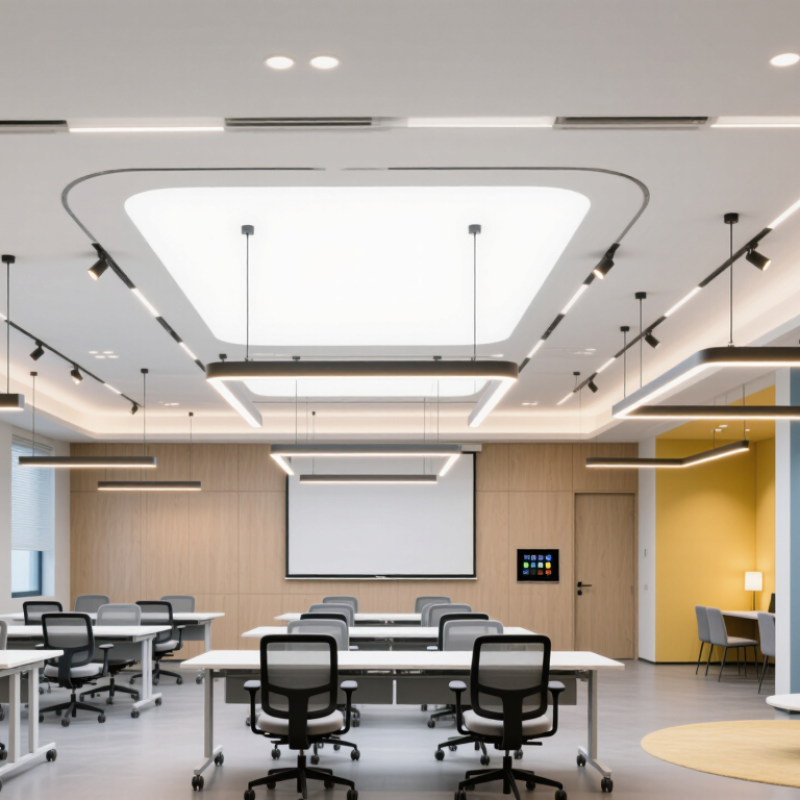
Multifunctional space lighting in China begins with a simple question: what must the room support today? A community hall may host a morning class, an afternoon meeting, and an evening performance. Each activity changes the required brightness, focus, and atmosphere. The design scope therefore includes more than choosing fixtures. It covers daylight, task needs, visual comfort, control settings, installation, and future maintenance.
Soft ceiling illumination can support general use, while adjustable fittings highlight a speaker, work surface, or display area. Keep glare off screens and provide clear routes through the room. In spaces with large windows, daylight sensors and blinds can help balance changing conditions. Controls should be easy to understand, even for occasional users. Too many scenes can confuse people. Start with a few useful settings, then test them with real activities.
Good design also depends on careful observation. Note where shadows fall on desks and where bright windows reflect on screens. Check color quality where people read, prepare materials, or view artwork. A full-scale mock-up can reveal issues that drawings miss. This step takes time, and it is tempting to skip it. That can be a mistake. The right balance may still need adjustment after the space is occupied, especially when schedules or furniture change.
Flexible lighting begins with the activity, not the fixture.
A dining table may become a laptop desk by afternoon, while a nearby screen needs low glare.
IEA reporting attributes around 30% of global final energy use and 26% of energy-related emissions to buildings.
That makes efficient controls relevant, but comfort still matters. Use separate dimming zones for desks, circulation paths, and shared tables. Add daylight sensors near windows, then keep manual controls within reach. Useful controls feel obvious. Complicated panels often go untouched.
Choose light levels for the task and verify them on site with a meter.
A bright ceiling alone can create reflections on screens and leave faces unevenly lit. Adjustable task lights help, especially when people share a room but not a task. Tunable color can support changing routines, yet it is not a cure-all.
Test scenes at morning and evening hours, with blinds in their usual positions. Small detail. Big difference.
In practice, some users will still override the settings; that is useful feedback, not failure. Review energy use and occupant comments after installation, then adjust schedules and sensor delays. A neat design can still miss the mark.
In a multifunctional space, one ceiling may serve a meeting, a lesson, and evening relaxation. Layered lighting makes those shifts practical: recessed downlights provide general illumination, while adjustable task lights brighten desks and counters. Wall washers can soften a presentation area without flooding screens with glare. Choose optics and mounting positions carefully; a bright fixture is not automatically a comfortable one.
Choose optics and mounting positions carefully; a bright fixture is not automatically a comfortable one.
Tunable white fixtures can shift from cooler work light to warmer evening light, while dimming creates useful intermediate scenes. Pair them with daylight sensors near windows and occupancy sensors in less-used zones.
The U.S. Department of Energy reports that LEDs use at least 75% less energy and last up to 25 times longer than incandescent lighting.
Its Energy Saver guidance offers a useful baseline, but actual savings depend on operating hours and controls. The IEA reports that buildings accounted for 30% of global final energy consumption in 2022, reinforcing the value of efficient lighting design.
Small details matter. In practice, sensor settings can feel intrusive, and preset scenes may not suit every user. Test them in the finished room, then adjust.
China Top Lighting Design for Multifunctional Spaces
Design Strategies for Different Multifunctional Environments
Multifunctional spaces need lighting that changes with use, not just with the clock. In an open-plan office, broad ambient light supports circulation, while adjustable desk lights help with close work. Use shielded fixtures to reduce reflections on laptop screens. Add separate controls for meeting tables and presentation walls. Small zones matter.
For classrooms and community rooms, even illumination helps people read faces and printed material. Dimming lets the same room shift from group discussion to projected content. In restaurants or shared living spaces, warmer local light can make dining areas feel distinct without darkening walkways. Keep switches understandable. Confusing controls often go unused.
Energy performance deserves equal attention. The International Energy Agency’s 2019 lighting analysis estimated that lighting accounts for about 15% of global electricity use. Efficient sources, occupancy sensors, and daylight-responsive dimming can reduce waste, but controls need commissioning. A sensor aimed at a bright window may leave a worktable underlit. Test scenes with real users, furniture, and daylight; one mock-up rarely reveals every problem.
Design Strategies for Different Multifunctional Environments
The chart compares typical maintained illuminance targets for multifunctional environments. Higher levels support visual tasks such as office work and learning, while lower levels create more relaxed atmospheres for dining, circulation, and display areas. Final lighting plans should be adjusted according to the applicable local standard, room geometry, daylight availability, and user requirements.
Evaluating leading lighting design solutions in China requires measured performance, not impressive renderings. The International Energy Agency’s Energy Efficiency 2023 report estimates that lighting consumes about 15% of global electricity. This makes efficiency a commercial and environmental concern. Review compliance with China’s GB 50034 lighting standard, then examine illuminance, uniformity, glare, colour rendering, and control response. A strong design should support meetings, retail displays, learning, and relaxation without constant manual adjustment.
I evaluate a space during several operating scenes. A desk may need clear, even light, while a lounge needs softer distribution. Record lux levels at work surfaces, UGR near viewing angles, and colour temperature changes. Check flicker with suitable instruments, not only with phone cameras. The U.S. Department of Energy’s Solid-State Lighting reports show that LED efficacy has improved substantially, but efficiency alone cannot prove visual comfort. I have seen efficient installations feel harsh. That weakness deserves attention.
Tips: Request commissioning records, lighting calculations, product test reports, and maintenance plans. Compare measured results with design promises. Include daylight sensors and occupancy controls where practical. Test scenes at night and during cloudy afternoons. Do not accept one sample area as evidence for an entire building. A reliable review also checks replacement access, control-system compatibility, and energy data after occupancy. These details often expose design assumptions that drawings hide.
Use broad ambient light for circulation and adjustable desk lights for close work. Shield fixtures from laptop screens. Small zones matter.
Give meeting tables and presentation walls separate controls. Dimming can shift the room from discussion to projected content while keeping faces visible.
Aim for even illumination on faces and printed pages. Test discussion and projection settings with people seated in the actual room. One setup may still miss something.
Use warmer local light over tables while keeping paths clearly lit. Check the contrast from a seated view, not only from the entrance.
Record illuminance on work surfaces, uniformity, glare near viewing angles, colour rendering, and control response. Measure flicker with suitable instruments, not a phone camera.
No. Efficient lighting can still feel harsh or leave a desk dim. Comfort matters too.
Use occupancy sensors and daylight-responsive dimming where practical, then commission them carefully. A sensor facing a bright window might leave the worktable underlit.
Request lighting calculations, commissioning records, test reports, maintenance plans, and replacement access. Compare measured scenes during daylight and at night.
China’s approach to Lighting Design For Multifunctional Spaces focuses on creating adaptable, comfortable, and efficient environments that can support several activities within one area. The design process considers how lighting affects movement, concentration, communication, relaxation, and visual comfort. Core principles include flexibility, user-centered planning, layered illumination, energy awareness, and the ability to respond to changing schedules and spatial needs. A successful solution balances ambient, task, accent, and decorative lighting while maintaining a coherent atmosphere.
Modern technologies such as adjustable LED fixtures, sensors, dimming systems, programmable controls, and smart scene management help spaces transition smoothly between different functions. Design strategies vary for offices, educational facilities, hospitality areas, retail environments, cultural venues, and residential interiors. To evaluate leading lighting solutions in China, it is important to consider light quality, adaptability, control convenience, energy performance, maintenance requirements, visual consistency, and long-term value. Together, these factors provide a practical framework for developing multifunctional spaces that are welcoming, efficient, and responsive to users.

SMOG Lights